Real-time SaaS
Upfront Games
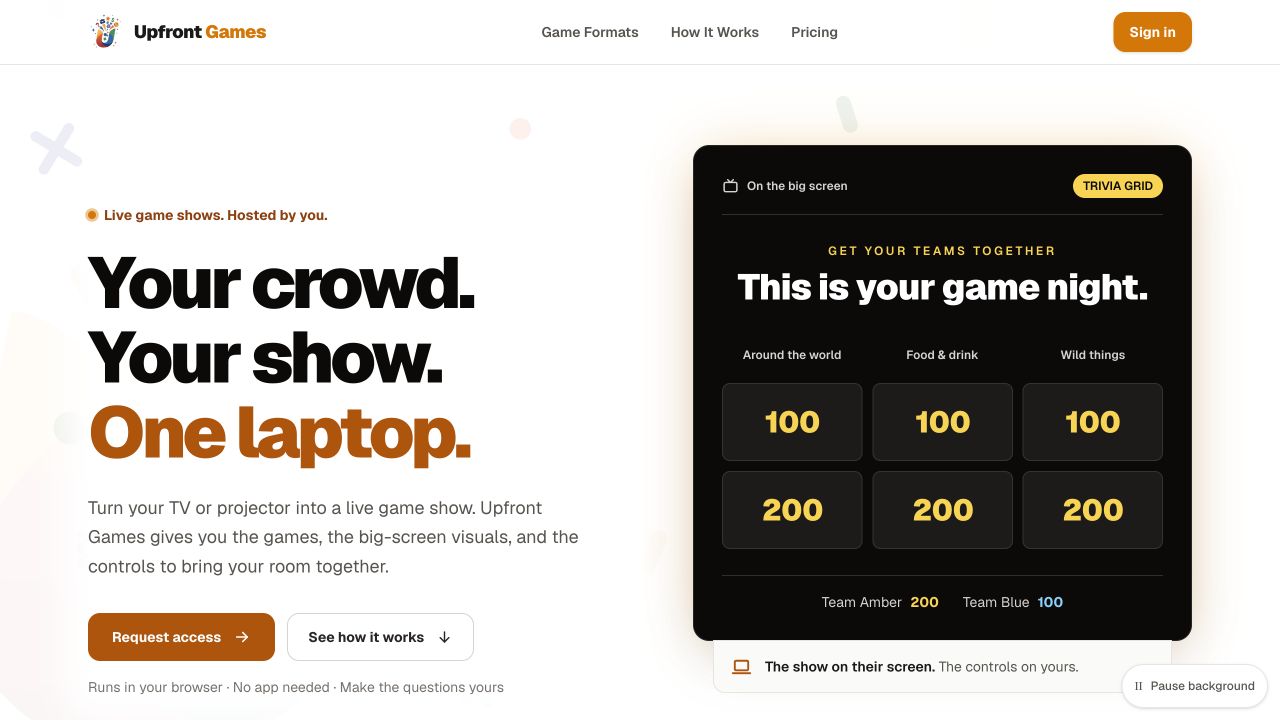
I built and deployed a live game-show platform with 14 game formats, connecting host controls, projector displays, and audience phones in real time. I owned the product architecture and delivery, including multiplayer state, organization accounts, and a shared engine that powers each game’s builder and live interfaces.
The problem
A live audience cannot wait for a refresh. Every buzz, vote, and score needs to stay consistent across devices and server instances, while the host’s answer key stays private.
How I approached it
I directed an AI-assisted build from architecture through deployment. PostgreSQL decides contested actions, server-sent events keep each screen current, and separate host, display, and phone snapshots define what each audience can see. A common game contract supports the builder and all three live interfaces.
Inside the build
- Built and deployed a live game-show platform on Google Cloud Run with 14 game formats, synchronizing host, projector, and phone views in real time via Server-Sent Events.
- Resolved competing player actions with PostgreSQL arbitration and idempotent commands, keeping buzz order and scoring consistent across server instances and retries.
- Idempotent command handling prevents retries from awarding points or submitting actions twice.
- Separate snapshots keep answer keys off the projector and room rosters off audience phones.
- Built AI deck generation with schema validation and a reserve–settle credit ledger.
- 4,100+ assertions exercise domain behavior without production secrets or a database.
The result
Deployed on Google Cloud Run with 14 complete game formats, automated delivery, and domain tests covering game engines, permissions, pricing, and real-time behavior.
Where it stands
Configured with a 400-phone room safeguard to match the pilot’s baseline Cloud Run and database tier, rather than an architectural limit. Supporting several thousand concurrent players in a single room is an infrastructure scaling step (provisioning higher-tier database connection pools, enabling the built-in Redis bus, and tuning container concurrency) verifiable through the codebase’s automated load-rehearsal harness. Stripe billing and AI generation are implemented, with production activation controlled separately.